Sunday, 3 March 2013

Ligature - that which ties you


The things that bind us are many and varied. Ties to family, to culture, to faith and to conviction keep us upright and braced against the vagaries of fate. Equally, however, our ties may hold us fast and prevent us from moving with the times even when change would be for the best.

Many years ago (I find myself writing that line more and more), my friend Peter Lenten and I designed a social studies unit on religion. For years we had been taking students to visit a mosque and a church and a synagogue. It occurred to us that, whilst these were important places for our students to keep visiting, few of our students would feel any personal connection with these religions. In fact, in a largely secular school, few of our students had much of a tie to conventional religion at all.


Peter had studied divinity many years before my many-years-ago and he explained that one etymology of the word "religion" is from the same Latin root as "ligature": historically "religion" has a sense of meaning "that which you are tied to". We decided to add one more place of worship into our tour and so took students to the largest shopping mall in our city. What we were interested in helping students explore was the way humans find meaning in their lives and the way that consumerism fills a defining space in the lives of many secular identities.


Attribution
 Some rights reserved by xiquinhosilva
Shopping malls, like churches and mosques and temples of many creeds and colours, can be inspiring places. As a young traveller I visited St Peter’s Basilica in Rome and stood, neck straining and head stretched, looking in awe up at the vastness of the dome. It was an inspiring experience. Despite my ambivalence about religion and the tensions I felt about the wealth represented in the Vatican, I was inspired by the sense of grandeur and the enormity of the space. This also is a feeling that I have often in Singapore. This largely secular island is filled with architectural extravagances which, despite my reservations about the resources involved, constantly amaze me. Architects place boat-like structures on top of casinos or turn lotus flowers into museums or build waterfalls and temperate rainforests inside vast, glass, refrigerated snow-domes.

http://sg.lifestyleasia.com/features/Entertainment/
singapore%E2%80%99s-latest-performing-arts-
centre-the-star-opens
Last Wednesday I visited a particularly inspiring space. Sharon, my wife, bought tickets for us to hear Nora Jones singing at the Star Theatre. The tickets were expensive but the theatre alone made me feel like we were getting our money’s worth. Vast escalators suspended in open space carried us up through glass floors and into suspended anti-chambers which took us to more escalators and then into a theatre space that dwarfed anything I have ever been in. A black roof dotted with star-like lights and two sweeping mezzanines which seemed bigger than half a football stadium provided space for 5000 people. Nora Jones was extraordinary, and, with the physical force of the music combining with the atmosphere of the theatre, the experience came as close as I think I am likely to get to religion. How interesting, then, to discover that the Star Theatre project is a joint venture between  a mall developer and a church and that each week thousands of Christians ride the escalators past the designer clothes shops to meet in this space.

I remain ambivalent about religion, but once again I have found myself standing in awe in a religious space.


Saturday, 16 February 2013

Seeing things


Half my lifetime ago, and a quarter of the world away, I started my first job in a tiny rural town on the edge of the Australian desert. At night I could jog 10 minutes over the crest of a hill and see no artificial lights, only stars. There were no public busses, no parks, no traffic lights, no supermarkets, one policeman, one doctor, one store, two pubs and a school of 100 students where I taught.

Every other weekend I drove 10 hours round-trip to visit the girlfriend I had left still studying in the city. The first hour of the drive was along a single-lane bitumen road that, in line with popular practice, I would travel at 120 kilometres an hour slowing to 100 to put my left wheels in the gravel if I met a car coming the other way. I might pass 4 or 5 cars before I hit the T intersection with the main highway and could relax onto the two-lane road that would carry me down to the city.

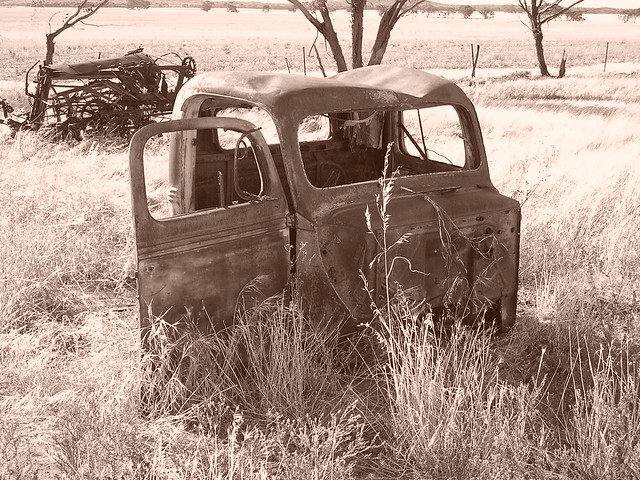
Half way along this first stretch of road was a small shop with a section of concreted footpath and a wooden bench. I assume the building was a shop because it sat so close to the road but it no longer served any commercial function. A section of wire fence on one side enclosed the dry weeds of what once was a garden.

As I whizzed by I would see two old men sitting on the bench. All I’d get was a snapshot glimpse of two hat-clad men sitting in the shade looking out across the road. I never stopped. They sat watching and I drove by.

What strikes me most, in retrospect, is the speed of it all. In a place of such stark beauty and timelessness, I passed, regularly, meters from these two men and knew nothing of them. Perhaps they knew that I was the young teacher - one of a regular cycle of young teachers who would stay a few years before moving on. Perhaps they didn’t notice me at all and just waited for the dust to clear and their view of the wheat paddocks to re-emerge.


AttributionNoncommercial Some rights reserved by Valley_Guy


In Singapore where cars are so expensive, I ride a bike. In the park each morning I pass dozens of old men and women out for their morning exercise. One man always waves and says “good morning” as I ride by. No dust here. The sky is much closer and regularly washes everything clean. Strange, though, that in such a fast-paced city I find myself travelling so much more slowly.

The younger me never took the time to wonder at what those two old men might be seeing as they looked into their memories. 


Saturday, 1 December 2012

ReMOval


Friends and family of Mo mourn his recent passing. Mo suffered one close shave too many. He leaves behind a stiff upper lip and a tear in the eye. Mo will be remembered for his important contribution to the cause of men’s health.

Sunday, 25 November 2012

Sea Eagle


In a quiet moment
Between classes
I look out the window
Of my 5th storey classroom
And see a sea eagle
Circling.

Not effortless; rather,
AttributionNoncommercialNo Derivative Works Some rights reserved by Corpus Rex
A spring wound up.
A poised potential that
Could release itself at any
Time to plunge into the
Tree canopy below.

...


I’m reminded of
A moment in childhood.
Looking out the window
Of the family car.
Speed and dust and the
Momentum of passing trees.

Beside the road
A rabbit came into view
And, in the same moment,
A Wedge Tail, glorious
And terrifying,
Plunged into the frame.

What I saw
Was like a photograph:
Rabbit,
Eagle,
Framed by a window.
Gone.

...


I wonder, now as I watch 
This new bird circling, 
What he sees?
Is his world just a rhythm
Of trees punctuated by 
Irregular kills?

Or, occasionally,
Does he look
Through windows
And catch glimpses
Of something profound
and glorious?

Sunday, 11 November 2012

Telling stories

Image from Wikimedia commons
The first film I directed starred Emmy Award winner Guy Pearce. To be fair, my friends Ben and Phil might also have some claim to the role of director but it was my Dad's camera, so I have always felt entitled to take credit. We shot the film in Super 8 in the back yard of my family home. Apart from Guy, this epic also starred our aging family dog, an overweight, corgi-beagle cross with limited mobility and no obedience training.

The film was called "Killer Dog" and followed the complex relationship between man and dog as it was developed over the 2 minutes shooting time that our pocket money allowed. Guy ran from the dog. The dog chased him (after a fashion). Close shot of the dog salivating. Wide shot of dog attacking Guy. Close shot of Guy on the ground with arm buried in a hole we had dug in the lawn (mother not impressed). Further close shot of previous night's roast lamb shank protruding from Guy's sleeve with considerable quantities of tomato sauce. Sound track taken from "Jaws". Film ends.

I was thinking about the film this week during training sessions with Jerry Maraia from Columbia University Teachers' College. Jerry spent the week skilling us up on Reader's Workshop techniques and helping us think about the effective teaching of reading and writing in our Middle School English classes.

One key technique in "Workshop" is the use of a "teaching point" and one key professional practice is the development of these teaching points. My students, I feel, often struggle with knowing where to begin and end their writing. Once started, their stories sometimes feel like a runaway train that will run on endlessly giving the reader no sense that they will ever be able to get off.

As kids, our early attempts at film-making taught us a useful lesson about shaping stories. The cost of film reels meant that we had only a few minutes to play with and editing was a difficult process that literally involved cutting and pasting strips of film together. The cost and effort involved meant that we spent a lot of time thinking about what we wanted our final film to look like. Planning was careful and we needed a clear and dramatic story.

"See it like a movie in your head" is a common piece of advice teachers give young writers. But it also helpful to think of that movie as shot in Super 8 - short and requiring some careful thought before you begin.

And one last piece of advice I could give: it's helpful if you can get Guy Pearce to act your main role because he provides a great hook into your writing.

(If you happen to read this, Guy, the film may still be in the cupboard at my parent's place and you'd be welcome to it)

Thursday, 25 October 2012

Singapore


The bus
Singapore Ian Tymms
On a school excursion
to "The Cement Works"
Drove down the
Sides of an open-cut
Mine to the
Bottom
Where we found ancient
Shark's teeth.

Now I live in a
Concrete tower looking
Down on the trees and
Earth below.
Cranes on every horizon
Are emblems
Of a desire to rise
Above the complex
History of this
Place.

But there are still
Shark's teeth in the walls.

Wednesday, 24 October 2012

Glasnost


Most of my posts to-date have focused on blogging and teaching. This post takes a very different direction; it’s the potatoes to add a little variety to my overly meat-rich diet.

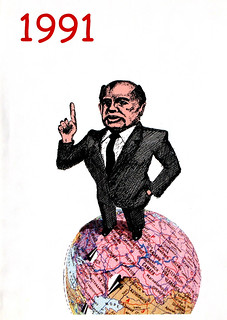
The United World College movement has just turned 50. The power and pervasiveness of Kurt Hahn’s original vision constantly surprises me as it finds expression in unexpected places. One recent voice to contribute to this conversation is Mikhail Gorbachev, a figure who, in my mind, stands in significance with the likes of fellow Nobel Prize winner Nelson Mandela and Mahatma Ghandi for the positive impact he has made on 20th Century politics. It is thus humbling and surprising to find Gorbachev taking the time to address the UWC community directly.

In his letter to the UWC movement, Gorbachev writes:

Dear friends,
Please accept my congratulations on the
occasion of the 50th anniversary of United
World Colleges. During the years of its existence
your movement has been able to considerably
influence several generations of students from
many countries in a spirit of mutual respect,
peace and sustainable development. Today, this
mission is as important as ever.

In today’s world, old threats to peace are
persisting and new ones are emerging.
The current economic crisis, the crisis of
international relations and the threat of a new
http://www.flickr.com/photos/osipovva/5498928857
arms race testify to the fact that the twenty
years after the end of the Cold War have been
largely wasted instead of being used to build a
more secure and just world order.
The economy of many countries is in deep
crisis. One of the causes of this crisis is the
model that has defined global development for
the past few decades, a model based on seeking
superprofits and overconsumption, on social and
environmental irresponsibility, making the
human being merely a cog in an economic machine.

I am convinced that a transition to a new model
is inevitable. But this requires joint efforts of the
scientific and academic community. I therefore
applaud the vigorous efforts of your movement
to support the right to peace, social justice
and sustainable development and stand up
against injustice and inequality. It is particularly
important that your students and alumni take
this stand not merely in rhetoric but by working
actively in various humanitarian, educational
and environmental projects on all continents,
thus showing an example of engagement and
civic responsibility.

I find this letter sobering. The last twenty years, he tells us, ‘have been largely wasted’. We have not build a ‘more secure and just world’ but instead have focussed on ‘superprofits and overconsumption, on social and environmental irresponsibility, making the human being merely a cog in an economic machine.’

As I sit here in Singapore, an employee of UWCSEA, it is hard not to take this analysis to heart. This is a wealthy country where Mercedes and BMWs are big, black and ubiquitous. There seems sometimes to be something a little inadequate in a lunchtime bake-sale which raises a few hundred dollars for a worthy cause when each of us live a lifestyle built, literally, on the cheap labour of imported workers.

What Gorbachev reminds me is that my footprint on the earth is real and I must always look carefully to see where I am treading. The UWC mission walks a precarious line as we both rely on the ‘economic machine’ for the resources that allow us to exist and simultaneously explore and question its workings. The social responsibility one has in a position of privilege requires significant and difficult reflection.

Gorbachev himself provides a good lesson in the value of working carefully from within ‘the machine’. His reform agenda for the Soviet Union through “perestroika” resulted in the dissolution of the USSR and the birth of modern Europe. The central tenant of that movement was the notion of “glasnost”, or “openness”, and it is this idea that I think has particular resonance with the UWC movement. Kurt Hahn’s belief was that if you could put people from different cultures together and educate them as equals, they would emerge from their schools with a greater potential to create a just and peaceful world. I think he would have liked the idea of glasnost.